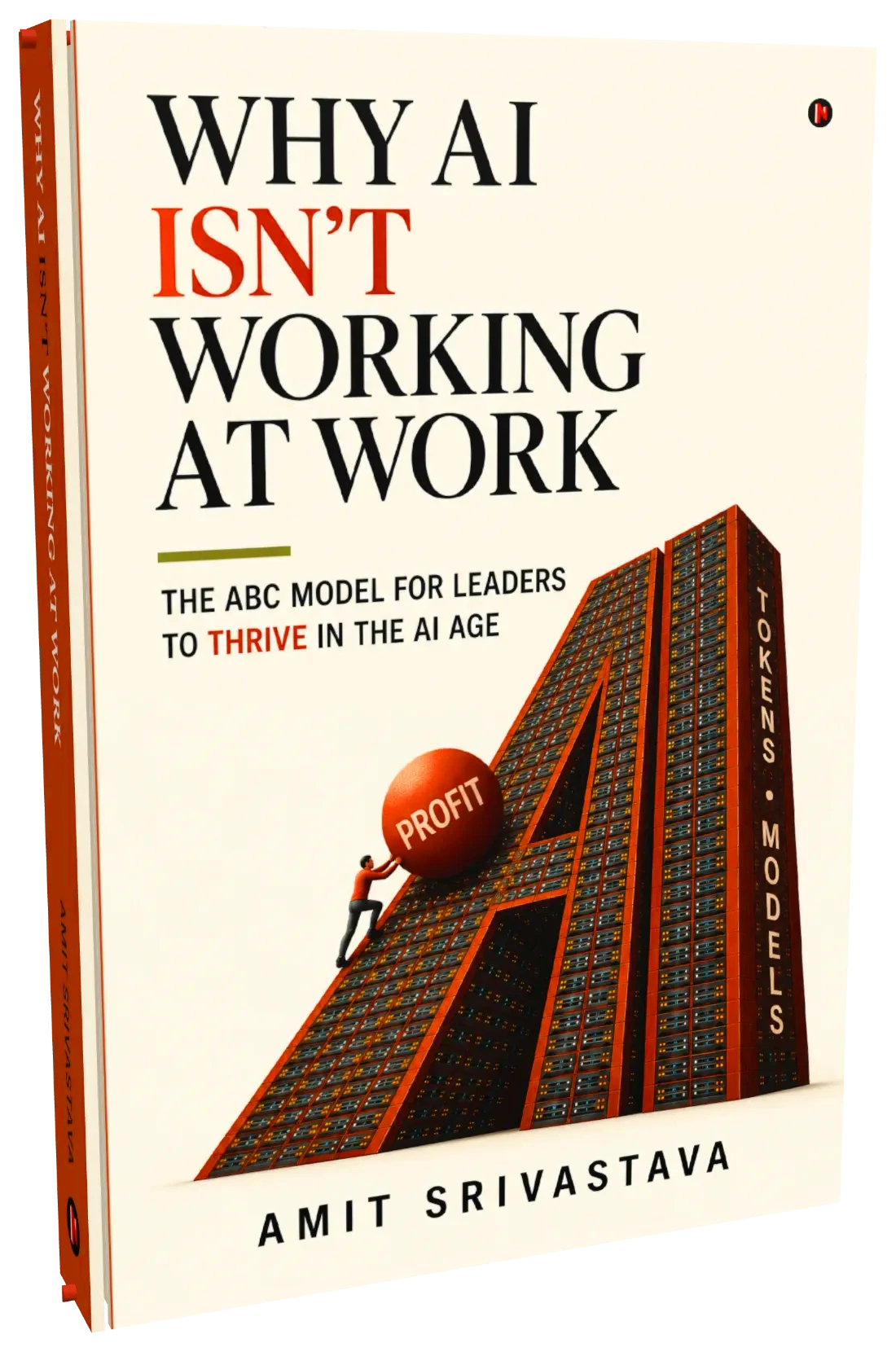
The story behind the book
When a machine appears to understand us, what should we entrust to it?
It started with androids, not spreadsheets. Seven ideas, from Kyoto to Berkeley, in one short film.
The story behind the book
When a machine appears to understand us, what should we entrust to it?
Seven ideas, from Kyoto to Berkeley, behind one book.
It began with androids.
Amit met Professor Hiroshi Ishiguro of Osaka University, who builds androids that look and move like people. His lab asks when we feel that someone is really there. Amit came away with a harder question. What does it mean for a machine to understand a person, and what happens when that understanding turns into an action?
Almost human is the hardest place to be.
The roboticist Masahiro Mori drew a simple curve. The more human a machine looks, the more we like it, until it is almost human. Then one small flaw feels deeply wrong. With faces, that feeling warns us. With fluent words, nothing does. AI writing sounds like a thoughtful colleague, so we assume a colleague’s judgement sits behind it.
The brain is a prediction machine.
Neuroscientist Anil Seth describes perception as a “controlled hallucination”. The brain guesses what is out there, then checks the guess against the senses. Language models predict too, one word at a time. A smooth paragraph gives no sign of whether anyone checked it. Fluency is not evidence.
Two kinds of empathy.
Cognitive empathy reads what another person thinks or feels. Affective empathy feels it with them. AI is getting good at the first. Researchers in robotics warn that a machine which reads feelings without sharing them could persuade without caring. Knowing how someone feels does not settle what we owe them.
Think first. Then ask the machine.
In a small study, 54 people wrote essays with ChatGPT, with a search engine, or with no help, while their brain activity was recorded. Writing with ChatGPT showed the weakest brain connectivity. People who wrote on their own first, and used AI later, remembered more of their work. Thinking skipped is thinking passed on.
Good at passing on. Weaker at inventing.
Psychologist Alison Gopnik and her colleagues call language models a cultural technology, like printing or a library. In one test, a hot cup of coffee had no sleeve. Children aged three to seven saw that a plant pot would hold it. The models chose the coffee lid, because the words go together.
Human ABC meets machine ABC.
People and machines both bring Assumptions, Biases and a narrow view of Complexity. Neither side automatically corrects the other. AI can challenge our assumptions and map the complexity. People bring context, scrutiny and someone accountable. The work now is to design how the two check each other, before an answer becomes an action.
Sources
- Hiroshi Ishiguro. Android research on presence, behaviour and brain responses. The 2024 meeting is Amit’s own account; Professor Ishiguro’s work is the setting for the question, not an endorsement of the book.
- Masahiro Mori, “The Uncanny Valley” (1970). The original essay, in the authorised English translation. A proposed relation, drawn as a concept, not a measured curve.
- Anil Seth, “Conscious artificial intelligence and biological naturalism”, Behavioral and Brain Sciences (2025). Argues that intelligence is not the same as consciousness, and that real artificial consciousness is unlikely on current paths. The phrase “controlled hallucination” is from his book Being You (2021).
- Roshni Lulla, “From the Trolley Dilemma to Robot Sociopaths” (2026). Separates reading another’s feelings from sharing them, and asks what follows for AI.
- Christov-Moore et al., “Preventing antisocial robots: A pathway to artificial empathy”, Science Robotics (2023). A viewpoint arguing that empathy built only on its cognitive side can encourage harmful behaviour.
- Kosmyna et al., “Your Brain on ChatGPT”, MIT Media Lab (2025). A preprint with 54 participants, and 18 in the final session. Small, early and widely debated.
- Yiu, Kosoy & Gopnik, “Transmission versus truth, imitation versus innovation”, Perspectives on Psychological Science (2023). Large models as cultural technologies: strong at passing on what people know, weaker at discovering what is new. The coffee-sleeve test is from the preprint version (arXiv 2305.07666), where children aged three to seven chose the object that worked and the models mostly chose the one whose name went with the usual tool.
Research-informed, not proof: none of these studies tested ABC.