Buying the fastest car does not win the race.
Put an everyday commuter in a Formula 1 car and you do not win a Grand Prix. Most companies bought the car, ran an hour of driver school, and forgot the race engineer.
By Amit Srivastava · 12 October 2026
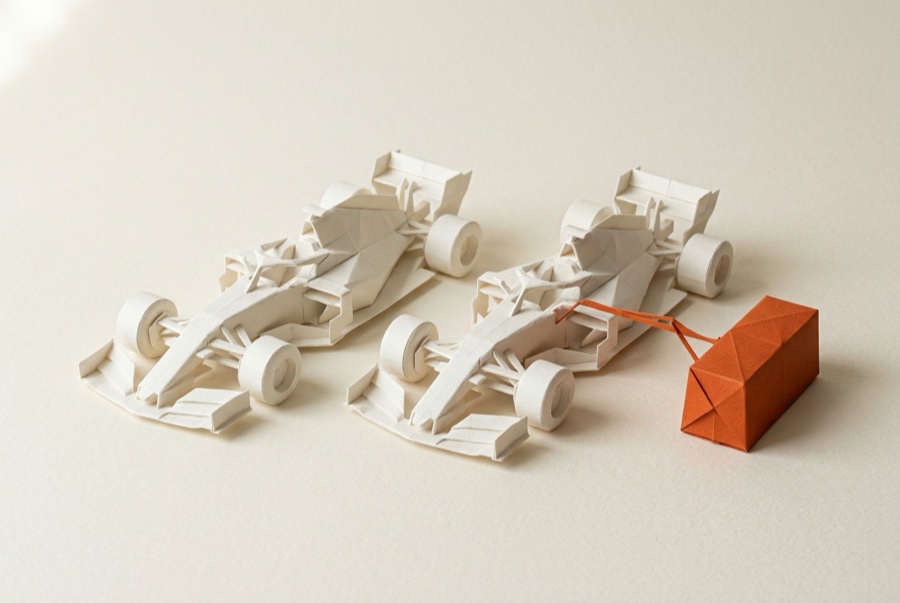
Put a world-champion Formula 1 driver into a family hatchback and enter them in Sunday’s Grand Prix.
Skill, nerve and racecraft will not give that engine the pace to lap with the field. Now reverse the experiment. Strap an unprepared weekday commuter into a current Formula 1 car and wave the green flag. Extraordinary power does not produce a podium finish. It puts the car into the barrier at the first corner, much faster.
Most executive conversations about AI stop at those two pieces: the person and the model. They forget the third seat that makes a modern racing team work.
The role missing from most AI budgets
At 300 kilometres an hour, a driver cannot read raw tyre-temperature traces, weather radar, fuel calculations and rival pit windows at once. Between the driver and the machine sits the race engineer.
The race engineer connects human judgement, machine capability and a changing track. They decide what context matters right now, which assumption about tyre wear just broke, and when the team must abandon Plan A.
In most companies I visit, procurement buys frontier AI licences (the car), and learning teams run a ninety-minute prompting session (basic driver training). Almost nobody owns the race engineer’s work: defining the real business problem before anyone prompts, feeding verified operational context into the workflow, challenging fluent answers and redesigning handoffs across teams.
Buying a more capable model does not automatically create a more capable organisation. Without race engineering, a faster engine simply scales confusion.
Power without preparation scales mistakes as fast as output.
Good driver, hatchback
People frame the problem well, yet manual steps cap how fast the team can execute.
Coordinated pit wall
Clear problem framing, live context, human escalation and redesigned handoffs (+15% issues/hr in live support).
Slow friction
Weak framing and low capability limit output, so errors remain small enough to spot by hand.
Fast car into the first barrier
Fluent drafts multiply downstream review queues while twenty rivals buy the exact same engine.
Three leadership mistakes the pit wall catches
When nobody owns the connection between the tool, the decision and the workflow, organisations repeat three connected mistakes, each visible through Assumptions, Biases and Complexity.
1. Mistaking desk speed for business performance
A published study of 5,172 customer-support agents by Erik Brynjolfsson, Danielle Li and Lindsey Raymond found an average 15 per cent rise in issues resolved per hour with AI assistance. Notice why it worked: the assistant sat inside a live workflow with clear resolution measures.
Contrast that with a sales team using AI to halve the time spent writing proposals while legal sign-off still takes two weeks and nobody has checked whether the pitch addresses what clients actually buy. Assumptions treat saved minutes as banked profit. Biases celebrate easy-to-count metrics (logins and drafts created) because decision quality is harder to score. Complexity hides the downstream review queue.
2. Mistaking rented capability for competitive advantage
Using AI to lower operating cost is sensible housekeeping. Assuming a rented model gives you a strategic moat is a category error.
In Formula 1, several teams can buy the same power unit. What separates the constructors’ champion from the midfield is chassis setup, pit-wall coordination, tyre learning and mid-race judgement: what strategy scholar David Teece called complementary assets. When every competitor in your market can subscribe to the same AI model before lunch tomorrow, advantage cannot live inside the software licence. It lives in proprietary customer insight, trusted data and workflows your rivals cannot copy overnight.
3. Mistaking a fluent recommendation for accountability
An AI assistant can rank layoff candidates, draft a pricing change or summarise acquisition risks in calm, balanced prose. Research by Mrinank Sharma and colleagues has also shown that instruction-tuned assistants can lean toward sycophancy, echoing the user’s implied preference rather than offering an unwelcome truth.
Even when the analysis is sound, a model has no skin in the game. It never faces the regulator, the board or the customer whose account was closed in error. Responsibility stays entirely with the human leader who signs.
Designing the pit wall on Monday
Your organisation does not necessarily need a new job title called Race Engineer. It does need that function visibly assigned on every consequential workflow:
- Before generation (Assumptions): Who defines the outcome we actually need, and separates measured facts from guesses?
- Before agreement (Biases): Who brings the counter-case and operational evidence from outside the chat window?
- Before commitment (Complexity): Who maps the handoffs across teams, names a single accountable owner and sets the condition for stopping if reality diverges?
Ask your leadership team one question this week: if your closest competitor buys the exact same AI system tomorrow morning, what in the way your team frames, checks and coordinates decisions will make customers still choose you?
Sources: Amit Srivastava, Why AI Isn’t Working at Work (September 2026, Ch. 3, pp. 42–44; F1 comparison is an illustrative thought experiment). Erik Brynjolfsson, Danielle Li and Lindsey Raymond, “Generative AI at Work,” Quarterly Journal of Economics 140, 889–942 (2025; 5,172 support agents). Michelle Vaccaro, Abdullah Almaatouq and Thomas W. Malone, Nature Human Behaviour 8, 2293–2303 (2024; 106 experiments). David J. Teece, “Profiting from technological innovation,” Research Policy 15, 285–305 (1986). Mrinank Sharma et al., “Towards Understanding Sycophancy in Language Models,” ICLR (2024).