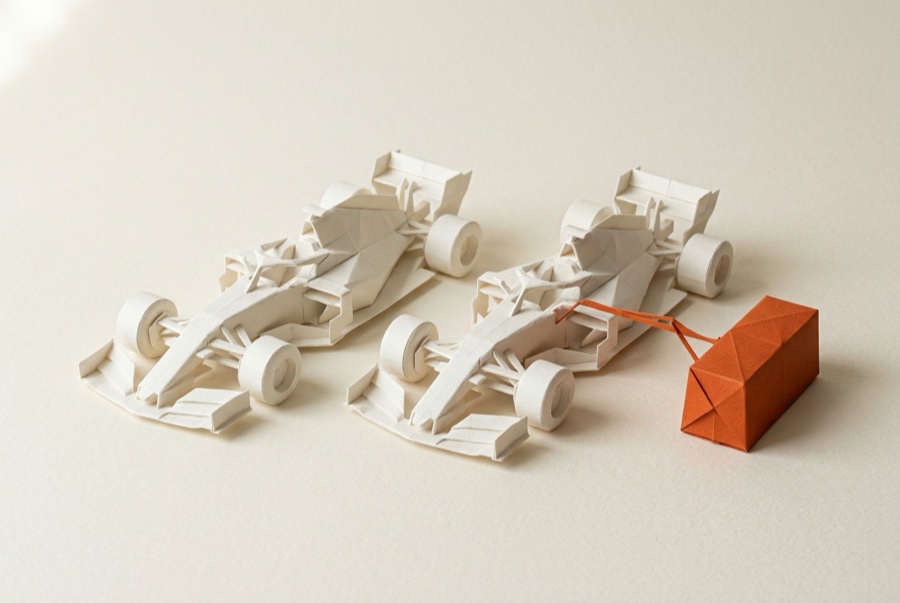
Faster chopping is not a better dinner.
A machine chops a sack of onions in seconds. The stove is full, and the dining room still waits. Why AI gains leak between the desk, the team and the P&L.
By Amit Srivastava · 28 October 2026

Imagine a restaurant owner who buys a very fast chopping machine.
At the prep board, the investment looks brilliant. A sack of onions that once took twenty minutes by hand is sliced in seconds. Step over to the range, however, and the cook only has two stoves. Chopped onions are piling up in tubs while the pans move no faster than they did last month.
Worse, when someone chopped onions by hand, they spotted a bad or unripe onion and set it aside. The machine slices everything alike. The plating now looks immaculate (we have all seen those gleaming slide decks and faultlessly polite emails), yet nobody checked the ingredients. And out in the dining room, where margins are actually made by serving more tables well enough that guests return, nothing has changed at all.
Three links between faster work and real profit
When boards invest millions in AI, they expect higher profits and stronger business results. What most are experiencing right now is simply tasks finishing faster.
Between a quicker task and a healthier profit-and-loss statement sit three distinct links, what I call the three Ts: Translation, Transmission and Transition.
Adoption is not value. A gain created at one desk has to pass through better work, better teamwork and a clear path to customer value before it reaches the accounts.
Time is saved at the desk. Work piles up at the handover. Profits barely move.
2 hours
At the desk
Less time spent on email each week, yet no measured shift into higher-value customer or product work.
40%
Across tables
Handed polished-looking AI workslop in the past month, costing the receiver ~2 hours per item to sift and fix.
80% vs 37%
At the P&L
1. Translation: is faster actually better, and where did the spare hours go?
Translation starts with one person and an AI tool. Suppose sending ten routine emails used to take four hours, and with AI it now takes one. Two immediate questions follow.
First, did accuracy improve alongside speed, or have we started trusting fluent answers without checking the ingredients? Second, what happened to the other three hours?
In a six-month field experiment tracking 7,137 workers across 66 firms, employees using an AI assistant spent roughly two hours less on email each week, yet researchers found no measurable shift in overall output or the kind of work completed. As recent perspectives from Deloitte and Anthropic have argued, future AI returns will depend heavily on how organisations redeploy saved time. Leaders need to ask plainly: with those spare two or three hours, are people meeting more customers, researching new products or building sharper skills, or simply sending more mail?
2. Transmission: did teamwork improve, or did work just move to the next table?
Even when individuals work faster, an organisation runs on handoffs. Transmission asks whether individual speed lifts team output, or quietly dumps a checking burden onto the next desk.
Across companies, roughly four in ten managers now report that their own workload has gone up because teams send far more AI-assisted material for review. Like the head chef handed tubs of ripe, unripe and half-cut onions, reviewers spend their evenings sifting through plausible drafts. In a September 2025 survey of 1,150 US desk workers by BetterUp Labs and the Stanford Social Media Lab, 40 per cent had received polished-looking but hollow AI workslop in the previous month, costing roughly two hours per item to untangle.
If one table clears its queue in ten minutes while overloading the next table for two hours, the company has not sped up. It has merely moved the queue.
3. Transition: twenty restaurants on the same street
There are only two ways a business makes money: cutting the cost of what it already does, or selling better value to more loyal customers at healthier margins. Most leadership teams have aimed AI almost entirely at cost cutting.
Look at the contrast in customer service. In 2025, Klarna famously boasted that AI was replacing hundreds of human agents, only to reverse course and rehire people when quality suffered. Airbnb studied that lesson carefully: it started with a focused pilot, built a hundred guardrails and kept a human in the loop to judge what needed escalation, lifting query resolution while protecting customer trust.
Now look five years ahead. Intelligence is becoming commoditised like tap water. For a hundred dollars a month today, anyone can rent a frontier model. If there are twenty restaurants on your street and every single one buys the exact same chopping machine tomorrow morning, the cost advantage cancels out.
When everyone on the street owns the same chopper, advantage never comes from the blade. It comes from leaders who redesign the kitchen to serve customers better.
Four questions to take back to your team
Before rolling out another wave of licences, sit down with your team and walk through four plain questions:
- Spare time (Translation): You are saving two or three hours a week. How are we redeploying that time toward customers, product thinking or skill?
2. Workload across tables (Transmission): Has work genuinely fallen, or has it piled up on managers and reviewers? And how many better decisions have we made in the past six months?
3. Path to profit (Transition): Beyond trimming cost, what are we changing so customers stay more loyal or gladly pay more?
4. What goes out: What proprietary company information are people typing into external AI engines that should stay inside local or governed models?
The machine can chop the onions. Only leadership can run the restaurant.
Sources: Oxford Group webinar, Realising ROI from AI: The Leadership Opportunity (27 October 2026). Dillon, Jaffe, Immorlica and Stanton, Shifting Work Patterns with Generative AI (arXiv, November 2025; 7,137 workers in 66 firms). Deloitte perspective on redeploying AI time saved (October 2026). BetterUp Labs and Stanford Social Media Lab, Workslop survey (September 2025; 1,150 US desk workers). McKinsey, The State of AI in 2026 (August 2026; 44% scaling AI, 37% reporting positive EBIT impact; 80% reporting individual productivity gain). PwC, 29th Global CEO Survey (January 2026; 56% reporting no significant financial benefit so far).